

ARVAL 26 & BEYOND









Driver Safety: A Data-Driven Approach to Fleet Performance and ESG Responsibility
Arval Mobility Observatory
8 Jul 2026
* This article is partly based on an exclusive interview with Åsa Haglund, Vice President and Head of the Safety Centre at Volvo Cars, conducted by the Arval Mobility Observatory Spain for its 2026 Road Safety Special.
Even as autonomous technology advances, cars are still driven by people, and therefore safety is and must be the primary consideration. This was Volvo's founding principle in 1927 – a continuous focus on driver safety that has remained central to the brand and a genuine competitive advantage. While new technologies may change the game in the future, this remains strikingly relevant. What has evolved is the complexity of acting on it.
Road safety has undeniably improved across Europe this century, yet the stats indicate there’s still much to be done. Around 19,400 deaths were reported on European roads in 2025. While that represents a 3% reduction from the previous year, most Member States aren’t on course to meet the EU's target of halving road deaths by the end of the decade.
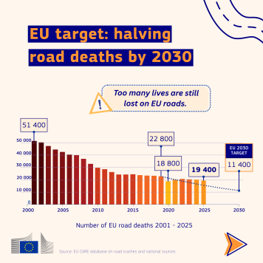
Source: Road safety statistics 2025 - Mobility and Transport - European Commission
Professional driving stands out as a major contributing factor. For example, in France, work-related road fatalities account for 42% of all road deaths. Against this troubling backdrop, fleet managers are faced with the challenge of improving road safety amid shifting forces – from new regulations and AI-powered prevention to ESG commitments.
When Compliance and Responsibility Point in the Same Direction
Long before ESG reporting obligations emerged, leading fleet operators recognised road safety as a core duty-of-care responsibility. Protecting employees, reducing injuries and ensuring drivers return home safely have long been central objectives of fleet management. Today, frameworks provide additional visibility and reporting requirements, but they primarily reinforce practices that many organisations already considered essential.
In July 2026, Phase Three of GSR2 – the EU's General Safety Regulation – comes into force. This extends mandatory requirements across all new vehicles to include advanced driver distraction warning systems and additional pedestrian and cyclist emergency braking.
The EU’s General Safety Regulation (GSR2): A Phased Approach
Mandatory ADAS requirements for all new vehicles sold in the EU, implemented in three phases
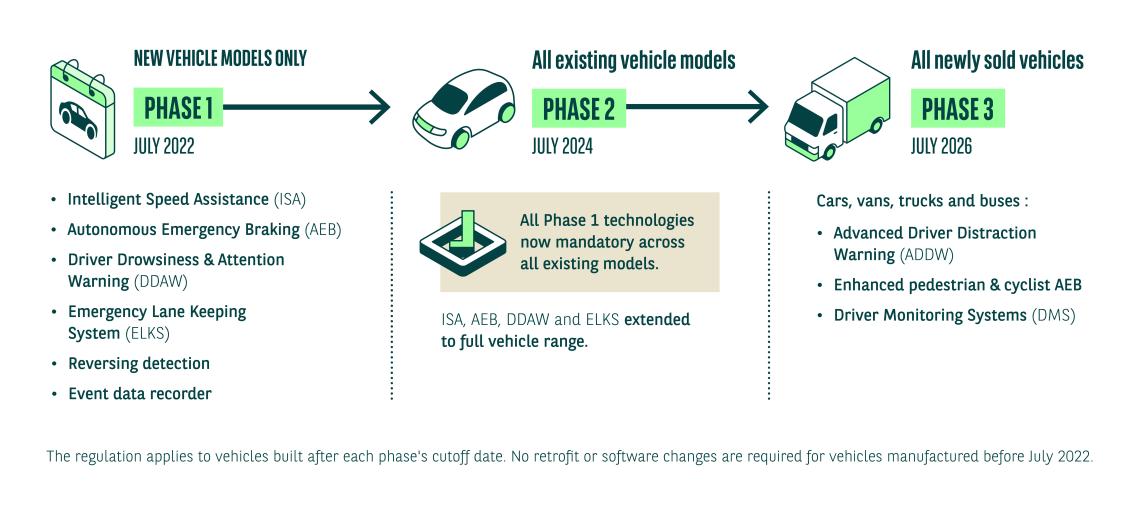
Source: New EU safety regulations mandate the use of ADAS
This shift is further reinforced by the Corporate Sustainability Reporting Directive (CSRD), which expands corporate reporting requirements on social impacts, risk exposure and preventive policies. In this context, driver safety is increasingly expected to be documented, monitored and integrated into governance frameworks, moving beyond principles into measurable commitments.
External regulatory matters are not the only consideration for fleet operators. Driver safety has evolved into a visible component of the social pillar of ESG commitments. Against this backdrop of corporate social responsibility, stakeholder expectations around duty of care are converging with regulatory ones.
Forward-thinking fleet operators are embracing this. They understand the distinct difference between each obligation and, crucially, that the two questions they pose must be answered together: Does our fleet meet the minimum regulatory standard? Are we doing everything reasonably possible to bring our drivers home safely?
Volvo's approach reflects a similar logic whereby regulation sets a floor, not a ceiling. This is outlined by Åsa Haglund, Vice President and Head of the company’s Cars Safety Centre: “We develop our cars based on our own stringent Volvo Cars Safety Standard, which is grounded in more than 55 years of real-world traffic accident research and goes above and beyond standardised safety testing.”
Electrification is changing the nature of road safety risks rather than eliminating them. Instant acceleration, regenerative braking and the higher weight of many battery electric vehicles can create new challenges for drivers who are not familiar with these technologies. Combined with the reduced noise levels of electric vehicles, which may affect interactions with pedestrians and cyclists, these characteristics require specific awareness and training. For fleet managers, the transition to electric mobility therefore creates an opportunity to revisit driver training programmes and ensure that safety practices evolve alongside vehicle technologies. Responsible driving behaviours can also support decarbonisation objectives by reducing unnecessary energy consumption, helping organisations lower operating costs while improving the overall efficiency of their fleets.
Understanding the Real Risk Factors
Technology, regulation and responsible business frameworks are fundamental elements of fleet operators' mission to improve driver safety, but they can’t easily control one crucial variable: human behaviour, such as attention, fatigue, and distraction.
Research shows that inattentiveness has jumped 168% as a contributing risk factor among commercial drivers – a reflection of the complexity of modern driving environments and drivers’ inability to sustain the required levels of attention. This behavioural risk is compounded by urban environments where vulnerable road users – pedestrians, cyclists, motorcyclists, and people with disabilities – are involved in 68% of road fatalities. For fleet managers running urban route networks, this represents an operational challenge.
As a pioneer of road safety, Volvo’s philosophy focuses on the unpredictability of real people, in real traffic. Having collected and analysed real-world crash data from more than 50,000 accidents involving Volvo cars and over 80,000 occupants, the company concluded that “every crash is different, and everybody responds differently.”
Acting on this successfully requires something that’s difficult to earn: driver trust. Haglund explains: "What drivers do not appreciate, and where they often feel the car is overriding their better judgment, is when it warns or intervenes in situations where the driver sees no clear risk or threat."
Other manufacturers are pursuing similar approaches. Renault Group, for example, has built its road safety strategy around a 360° model covering prevention, correction, protection and rescue. The company also relies on decades of accidentology research and behavioural studies to better understand how real drivers interact with vehicles and road environments.
The implication for fleet safety mirrors this, with generic risk assessments and blanket policies only partially helping. To achieve a holistic approach to safety, operators must understand how specific drivers behave in specific conditions. The organisations that do find that driver safety is not just a duty of care obligation; it’s a direct lever for risk management performance and an evolving component of ESG accountability.
From Reactive to Predictive: How Data is Rewriting Road Safety
Access to vast datasets is reshaping road safety by enabling the identification of risk patterns across rare and complex scenarios before they become accidents – something traditional crash testing never could.
One example is Lytx, a global provider of video telematics and driver safety solutions. Drawing on data from more than 341 billion miles driven worldwide, its 2026 Road Safety Report shows how large-scale driving data can reveal behavioural risks that would otherwise remain invisible. For instance, the report recorded a 16% increase in lower-severity collisions. Insights like these demonstrate the value of large-scale driving data, helping fleet operators detect trends early and take targeted action before risks escalate.
Reactive vs. Predictive Safety
The shift from reactive to predictive safety and what it means for vehicles[1]
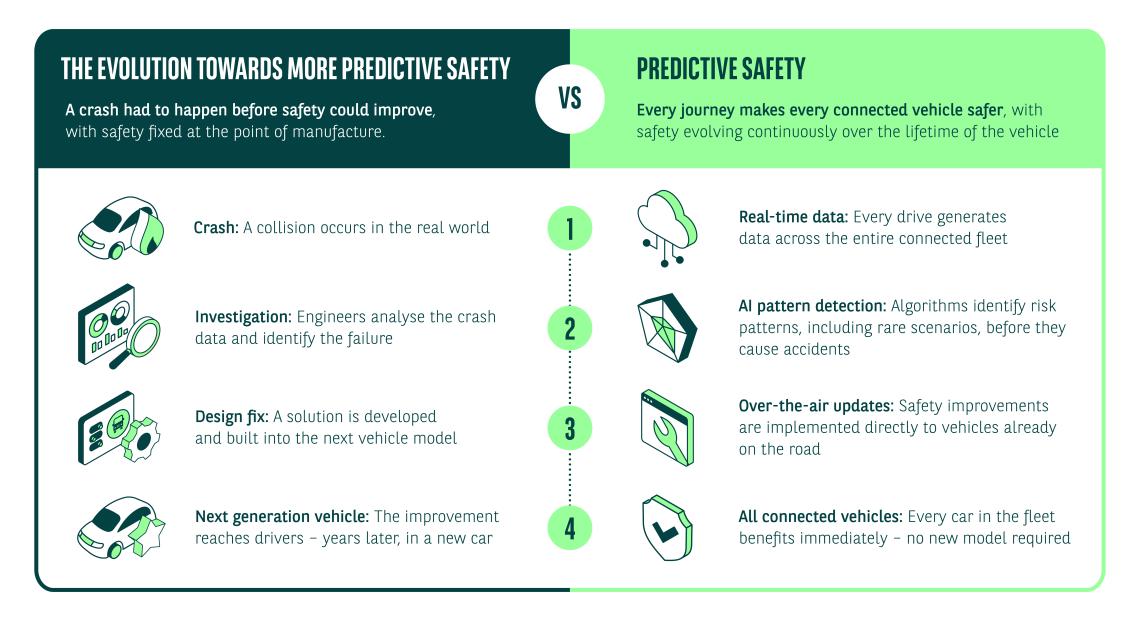
These steps reflect a common industry trend, but availability and implementation vary by manufacturer and model.
The use of connected vehicle data is also creating new opportunities to improve driver behaviour. Renault has developed tools such as "Safety Score" and "Safety Coach", which analyse driving patterns and provide personalised guidance based on identified risk indicators. Such approaches illustrate how safety is increasingly becoming a continuous process rather than a one-off vehicle specification.
Indeed, connected services highlight how safety can increasingly rely on real-time information sharing. For example, Škoda's Traffication platform can alert drivers to approaching emergency vehicles and other road hazards before they become visible, giving them additional time to react and helping to reduce stressful and potentially dangerous situations.
Volvo’s connected fleet is demonstrating predictive safety by generating continuous real-world driving data from every journey – not just accidents. By augmenting these outputs with AI-generated virtual environments, it can reconstruct safety-related events and produce thousands of edge-case variations in days rather than months – expediting the development of advanced safety software.
Software-defined vehicles are creating new opportunities to deploy safety improvements more rapidly than in the past. While this approach is still evolving across the industry, it has the potential to shorten the time needed to introduce certain safety enhancements and driver assistance functions.
The days of treating vehicle safety procurement as a decision made at the point of acquisition are over. Organisations must strive to continuously improve safety by integrating real-time driver monitoring, continuous data analysis, and regular safety reviews into their ongoing fleet management strategy.
Embedding Safety in Organisations
For many organisations, driver safety has long been a core operational priority rather than a compliance exercise. Companies managing large vehicle fleets have historically invested in training, prevention and risk reduction because protecting employees and ensuring business continuity are fundamental responsibilities. Today, advances in connectivity, telematics and analytics are creating new opportunities to strengthen these long-standing safety programmes and make interventions more targeted and effective.
For example, coaching on device use surged 40% among leading fleets in 2025 – not because regulation demanded it, but because of a strong understanding amongst fleet operators that driver behaviour requires continuous attention, not occasional intervention.
Making the most of these technologies requires careful consideration of driver privacy and data protection. While connected vehicle data can provide valuable insights into risky behaviours and help prevent incidents, organisations must balance these benefits with transparency, clear governance and respect for applicable data protection requirements. Building driver trust is therefore as important as deploying the technology itself, ensuring that safety initiatives are perceived as a tool for protection rather than surveillance.
To earn driver buy-in, these safety programmes must not feel imposed. Haglund explains, "having high-quality sensing both outside and inside the car is crucial" – not just to detect risk, but to ensure systems deliver the precision needed to earn driver confidence. That trust, underpinned by data, turns safety technology into safety culture.
Fostering a proactive and continuous safety culture also requires HR and governance support. Duty of care obligations, ESG reporting, and corporate risk frameworks must fit to make driver safety a measurable commitment that’s tracked alongside cost and efficiency – and managed with the same rigour.
Driver Safety: A Bridge Between Performance and Responsibility
For fleet operators, road safety has never been limited to the vehicle itself. It has always involved a combination of people, processes and technology. What is changing is the growing availability of data, connectivity and predictive tools, enabling organisations to better understand risks, tailor interventions and continuously improve safety outcomes.
Manufacturers are increasingly using data and connectivity to prevent incidents before they occur. For fleet operators, these developments reinforce the importance of combining vehicle technology, telematics and human-centred safety programmes to create safer mobility ecosystems.
[1] Source: Interview with Åsa Haglund, Vice President and Head of the Volvo Cars Safety Centre
Source: Safety: Innovative assistance systems from higher vehicle segments - Škoda Storyboard