

ARVAL 26 & BEYOND









How ESG reporting can drive change in corporate mobility: Key insights and recommendations
Arval Mobility Observatory
18 Feb 2026
Many businesses still see Environmental, Social, and Governance (ESG) reporting as yet another compliance obligation – which means they’re missing out on its potential to drive innovation and positive change. However, when used correctly, ESG requirements can guide companies towards adopting mobility solutions that are sustainable, cost-efficient, and employee-centric.
In this article, we’ll look into the details of the different strategies you can use, from fleet electrification and low-emission mobility, to more employee-centric and flexible programs. We’ll also explain how you can use ESG reporting to build better systems and improve your fleet operations, starting now.
What is the role of ESG in corporate mobility?
Navigating ESG reporting is a complex task involving work across its three main pillars: Environmental (E), Social (S) and Governance (G) requirements. But using those pillars also offers a practical framework for rethinking your corporate mobility policy, each shaping a different aspect of how businesses manage employee travel and fleet strategies. Let’s look at each.
Environmental (E)
Mobility is a significant source of an organization’s environmental impact through pollution or carbon emissions. Here we are looking specifically at daily corporate mobility, rather than long-distance travel, which represents a separate and often bigger source of emissions.
ESG reporting brings these impacts to light and pushes companies to take specific action to decarbonize their mobility, mainly through the electrification of fleets (on which you can read more in our 2024 Global Electrification Report). It also encourages investment in lower-emission commuting options, such as public transport subsidies, incentives for cycling to work, and ride-sharing programs – plus, a more sensible approach to business travel.
And indeed, practices are changing: According to our own research, nearly 80% of employees use alternative mobility services provided by their employers.
Social (S)
Employee well-being is becoming an important consideration when designing mobility strategies. Workers themselves expect companies’ mobility policies to accommodate different working styles, commuting needs, and schedules – and more companies become conscious of the need to create a better employee-centric working environment, including for employees with disabilities or who live far away.
Frameworks such as the EU’s Reasonable accommodation at work require efforts in this direction. Although they usually stop short of prescribing specific measures related to corporate mobility, businesses can use this opportunity to proactively address employees’ diverse mobility needs and provide personalized transportation options.
Rather than being stuck in traffic (which can be a major source of stress), employees can opt to use a different type of transport, or, if your policies allow it, work remotely a part of the time. Work from home policies and return-to-office mandates are among the elements to consider when designing comprehensive mobility policies.
For employees who need to spend long hours on the road, companies are implementing measures to support them and ensure their comfort and safety. For this, organizations provide dedicated services, vehicles adapted to employees’ usage and needs, additional driver training, and risk awareness programs to reduce road accidents.
Governance (G)
Governance is where this all comes into practice, defining how companies structure their policies, ensure compliance, and make transparent decisions around mobility procurement and data use.
Mobility reporting now includes KPIs linked to carbon emissions and vendor policies and sustainability standards. And companies can take a proactive approach in that regard. A good example of this would be IKEA including co-worker commuting and business travel in its climate footprint. IKEA’s KPI for co-worker commuting and business travel is to reduce greenhouse gas (GHG) emissions from employee travel by 50% per co-worker (i.e., in relative terms) by FY2030, compared to the baseline year FY2016. This target was established as part of IKEA’s broader climate strategy, which uses FY2016 as the baseline year for all major emissions reduction goals.[1]
Good governance also means partnering with vendors to meet ESG criteria, whether in looking into how vehicles are sourced, analysing lifecycle emissions, or handling sensitive employee data correctly.
Additionally, to define an accurate Mobility Policy Governance, establish a cross-functional steering team (HR, CSR, fleet, finance) to ensure holistic oversight and proactively design mobility policies ahead of regulatory changes. Monitor compliance and sustainability using CO₂ tracking tools and telematics for accurate performance reporting.
Can ESG reporting be a catalyst for change?
ESG reporting is, as the name suggests, a reporting obligation – but beyond that, it also shapes how companies operate. “What gets measured gets managed” stated Peter Drucker, a founder of modern management.
ESG frameworks create both pressure and incentives for companies to be more transparent and sustainable. By measuring and communicating their environmental and social impact, they’re forced to not only look into the proverbial mirror, but also to satisfy the demands of their customers, employees, partners, and the countries in which they operate. At the same time, ESG reporting helps companies adopt a wider perspective and rethink the way they function based on their impact; this enables them to assess risks more precisely and even identify and seize new business opportunities.
Data-driven decision making
Reporting on their impact on the environment and society forces companies to adopt a data-driven approach and establish baselines and goals across many different areas:
- Mobility emissions
- Vendors’ own commitment to ESG obligations
- Employees’ health, safety, and overall well-being
And, once they identify the biggest opportunities for impact – with the help of reporting data – they can then work to optimize routes, electrify fleets, and offer a multitude of flexible, low-emission commuting options.
Technology is a key enabler in collecting actionable data – telematics, carbon accounting platforms, and employee mobility surveys can be used to first look at the current situation, and then to set targets, define action plans, and track improvement. Data also facilitates the ability to support substantiated claims regarding advancements in sustainability.
Regulatory and investor pressure
Investors are increasingly linking ESG performance with long-term viability. Additionally, regulatory pressure is also increasing. Mandatory disclosures, such as those aligned with the Corporate Sustainability Reporting Directive (CSRD) in the EU, are expanding what companies must report on, including Scope 3 emissions (to which employee commuting and upstream emissions of fleets, such as from manufacturing processes, can contribute significantly).
For companies with large fleets or international operations, proactive reporting and innovation in mobility can help build stronger investor confidence.
ESG risk management
ESG frameworks can also prompt companies to assess exposure to climate risks and extreme weather (hail, floods, fires), regulatory developments and challenges (such as increasingly strict Low Emission Zones standards), and reputational risks.
By assessing those risks and building the relevant reporting processes, organizations reduce their exposure to them and are better prepared to meet future challenges.
Evolving employee expectations
The workforce is also a driving force behind ESG-focused mobility changes. In fact, employees are paying close attention to what you offer. According to the 2024 Arval Mobility Observatory employee mobility survey, for 62% of them, corporate mobility offerings can impact their choice of a workplace, and 72% of those planning to leave their jobs within six months rate it as a top factor.
Offering more convenient and sustainable commuting options can, therefore, be a key differentiator for companies and help them attract top talent, in parallel with flexible working options.
Beyond their expectations, it’s also important to recognize that employees may resist change and may not always agree with new mobility processes and the necessary adjustments they must make. That’s why it’s key to make the experience as smooth and straightforward as possible and invest in education and support. Change takes time, and effective change management is an important component of any major transition.
How can you use ESG reporting to drive innovation in mobility policies? 5 key actionable insights
Turning ESG commitments into tangible mobility outcomes for your employees requires structure, discipline, and engagement. Below, we’ve outlined 5 key initiatives you can use to align ESG reporting with corporate mobility.
1. Audit your current mobility footprint
To enable change, you need to know where you stand first. For this, a data-driven review of how employees travel and how your fleets are being used is a must. You can start by tracking the following:
- Commuting patterns
- Business travel habits
- Fleet usage – including underused and high-emission vehicles
This will allow you to assess which areas generate the most emissions and set meaningful targets and track progress.
2. Align mobility policies with ESG goals
Mobility policies need to be connected to:
- Environmental targets, such as reducing CO₂ emissions
- Social objectives, such as inclusion, employee health, and impact on society
Governance requirements, such as establishing strong and transparent relationships with vendors and maintaining ethical procurement policies and governance standards (e.g. transparency and ethical procurement).
That might mean you need to start phasing out internal combustion engine (ICE) vehicles and electrifying your fleet or rethinking travel approvals for business trips (or, better yet, grouping activities together for more impact). Importantly, it also requires you to make sure mobility benefits are distributed in a way that makes the most sense for your employees and business as a whole.
3. Leverage technology and data
To monitor fleet performance, emissions and driving patterns, fleet managers can use telematics. This, then, would enable them to optimize routes, create better schedules, and ensure optimal vehicle use.
Research also shows that around half of fleet TCO (through costs like fuel, maintenance, and insurance) depends on driver behaviour:
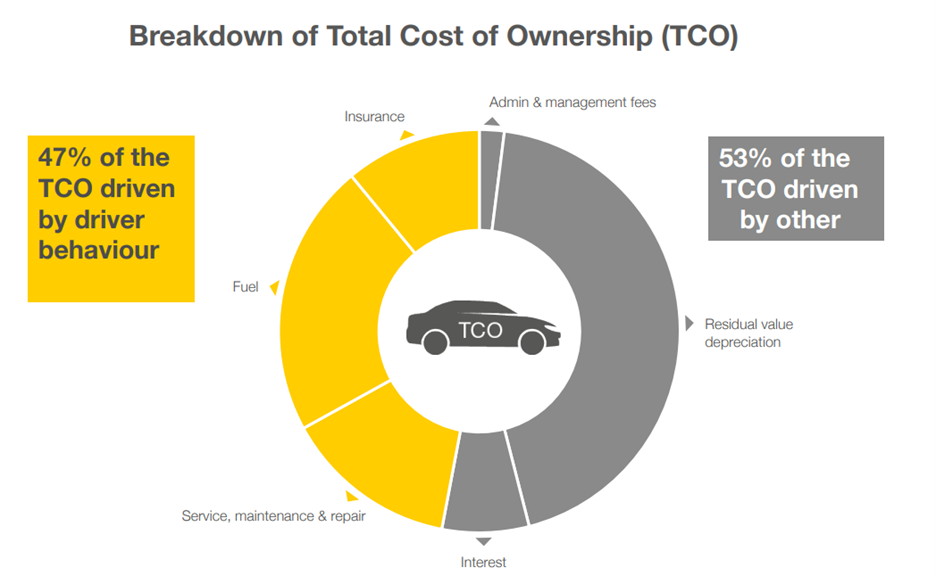
Driver behaviour accounts for 47% of TCO (Source: DriveTech, The Impact of Driver Behaviour on Vehicle Running Costs)
As for employees who don’t use a vehicle for business travel or commuting, businesses can use satisfaction surveys, track reimbursement requests, and proactively seek out feedback on how to improve mobility policies.
4. Engage employees in mobility planning
Actively engaging employees in the decision making process enables you to get their buy-in and participation – which is crucial for designing more sustainable, efficient, and innovative corporate mobility solutions.
For this, you need to get employees’ feedback and seek to analyse and understand their needs, preferences, and pain points. What’s crucial, however, is to act on the received feedback, and use it to design and test different approaches and ways of commuting. Facilitating carpooling, providing a budget for cycling to work, or subsidizing public transport can all play a role – but make sure you ask your employees what they want.
5. Build partnerships with sustainable mobility providers
The next step is to analyse your existing partnerships and seek out to build new ones with providers that specialize in sustainable solutions, such as electric vehicle leasing companies or mobility pass solutions that give employees access to different transport options.
This will speed up the transition to more sustainable options – and will also provide employees with a wider array of options to choose from.
Corporate mobility is a key ESG opportunity – and you should treat it as such
Employee mobility is at the crossroads of environmental impact, social responsibility, and operations, which makes it one of the most immediate and high-impact areas for innovation enabled by ESG reporting.
One of the most compelling aspects of sustainable corporate mobility is that environmental impact reduction often goes together with cost savings. For example, opting for smaller vehicles not only lowers emissions but also reduces acquisition and operating costs. Implementing eco-driving programs can lead to more efficient fuel consumption, directly decreasing both carbon footprint and fuel expenses.
Fleet electrification – including that of commercial fleets – further amplifies these benefits. It delivers measurable emissions reductions, helps you meet regulatory requirements faster, and sends a clear message to investors.
Additionally, companies can adopt flexible, employee-centric commuting benefits: public transport subsidies, cycling incentives, carpooling apps, or even mobility budgets that allow people to choose what works best for them. This makes commuting more manageable for employees, but there’s still room for improvement. Currently, 50% of employees are satisfied with current corporate mobility offerings (up from 45% in 2022).
Forward-thinking companies will see this not only as a logistical challenge they need to overcome, but also as a key opportunity to innovate. If you use ESG frameworks to rethink and improve your mobility programs, this will benefit your employees, the environment, and, ultimately, your business as a whole.
[1] AMO, Future of Mobility White paper, Oct. 2025; Ikea Sustainability Report 2024