

ARVAL 26 & BEYOND








Autonomous Vehicles: The Gap Between Transformation and Reality
Arval Mobility Observatory
24 Sep 2026
Autonomous Vehicles: The Gap Between Transformation and Reality
Autonomous vehicles (AVs) have the potential to redefine the entire mobility value chain, from vehicle ownership models and fleet economics to urban mobility systems and the way people use travel time. Autonomous mobility could accelerate the transition from asset ownership to mobility services, create new operating models for fleets and logistics operators, and fundamentally redefine the role of vehicle manufacturers and technology providers. Yet, despite this transformative potential, deployment remains gradual and uneven.
Autonomous driving is one of the most visible applications of Physical AI, where artificial intelligence interacts directly with the physical world. Together with connectivity and electrification, it is driving a broader wave of change in vehicle innovation. But within this evolution, the development of vehicle autonomy is following a non-linear trajectory, dictated by forces that present barriers to progress: safety issues; technological complexity, cybersecurity risks, regulatory constraints, and operational realities.
Commercial deployments do exist. Robotaxis are generating millions of paid rides in selected US and Chinese cities. autonomous trucks are moving freight on defined highway corridors. But these are controlled projects, not mass rollouts.
For fleet and mobility stakeholders the challenge is to understand and to anticipate the current state of play: what AVs can deliver, the barriers to progress, and what that means for them now and in the future.
Why autonomous Vehicles Matter for Fleet and Mobility Stakeholders
Beyond the current gap between ambition and deployment, the expected benefits of autonomous vehicles remain substantial. This is especially true when they are assessed through a broader mobility lens. Almost all high-autonomy use cases are expected to rely on electric platforms. As a result, AVs could help accelerate the transition towards lower-carbon mobility. They could also improve energy efficiency through smoother, data-driven driving patterns and eco-driving operating modes.
At system level, their greatest potential may not come from replacing today’s privately owned vehicles one-for-one, but from enabling a shift from vehicle ownership to Mobility-on-Demand. Shared robotaxis, autonomous shuttles, ride-pooling and on-demand corporate mobility solutions could increase vehicle utilisation, reduce the number of underused assets and limit parking space requirements.
This creates a broader opportunity for corporate fleet managers.
It means expanding the focus from vehicle management to a broader management of mobility needs, while continuing to oversee fleets of autonomous vehicles.
Organizations may increasingly combine company cars, shared mobility solutions and on-demand services to deliver the mobility employees require, while optimizing fleet size, pooling usage and extending asset utilisation. Higher utilization rates could also support circular economy principles through longer vehicle lifecycles, improved maintenance strategies and more efficient use of resources.
Autonomous driving could also create new productivity opportunities. Just as digital technologies enabled remote working, autonomous mobility could progressively support the emergence of mobile working. As driving tasks become increasingly automated, travel time could evolve into productive time, enabling employees to prepare meetings, collaborate, manage administrative work or access digital services while travelling.
Autonomous Vehicles: Understanding Levels and Definitions
The common assumption that autonomous driving is a binary concept defined by driverless vehicles is completely at odds with the operational reality.
Vehicle automation is a spectrum ranging from driver assistance to full automation. The SAE International classification system defines the six levels of driving automation:
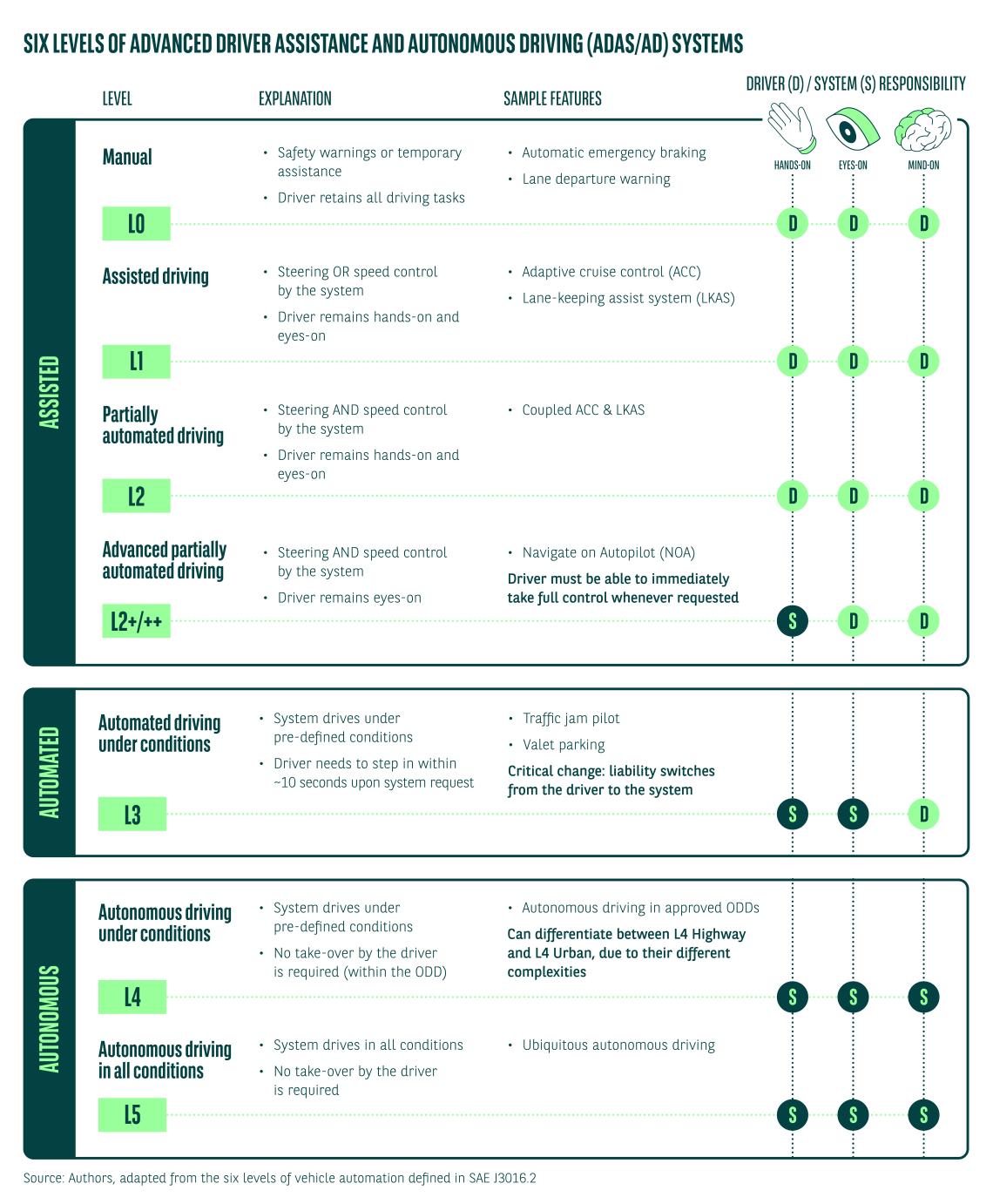
Description: The SAE J3016 classification system defines six levels of driving automation, from L0 (no automation) to L5 (full autonomy in all conditions). Most new vehicles entering the market operate at L2 or L2+.
The difference between assisted driving and true autonomy carries important implications in terms of driver responsibility, liability and operating models.
At level 2 or 2+, already the most dominant technologies in new cars, the vehicle controls steering and speed simultaneously[1]. Still, the driver remains in control of the driving process. These increasingly common technologies deliver assistance – lane-keeping, adaptive cruise control, highway autopilot – reducing driver effort but not responsibility.
At level 4, the vehicle drives itself within a defined operational domain, with no driver intervention required. However, this true autonomy remains restricted by persistent technical challenges, safety requirements, and regulatory constraints. Only 4% of new personal vehicles sold in 2035 are expected to feature L4 capabilities[2].
The market is in a transitional phase where progress is visible but uneven. In 2025, AVIA reported that AVs have driven over 145 million miles on US public roads – a twofold increase since June 2024 [DDOT report, page 12]. However, the sheen is taken off these figures by the reality: this progress is concentrated in specific, controlled deployments.
A Fragmented Landscape: Technology and Adoption Across Regions
AV development is experiencing differing trajectories across the three leading markets: the US, China, and Europe – reflecting differences in regulation, industrial strategies, and deployment models.
The US
The US leads on early commercial deployment. For example, robotaxi operators complete over 450,000 commercial rides per week, compared to 250,000 in China. However, a fragmented regulatory environment remains a barrier to success. While 29 states have enacted legislation related to AVs, laws differ widely in terms of where they’re permitted and whether a human safety operator is required [SCOR paper, page 4]. In the absence of an overarching federal framework, innovation is forced to advance through private and geographically limited ecosystems.
San Francisco has become a national testbed for autonomous service, and its experience demonstrates what that lack of oversight looks like in practice. Real-world incidents – including crashes, stalled vehicles, and interference with emergency responders – have exposed the gap between rapid deployment and effective regulation. Each incident points to the same underlying issue: current state and federal permitting regimes lack the safety, transparency, and operational controls needed to manage the risks effectively.
China
China leads the way in terms of large-scale deployment capacity. In Wuhan alone, more than 500 level 4+ AVs are in operation on the roads[3] . Across the country, this impressive scale is supported by a centralised governance model that enables faster experimentation across designated test zones covering 32,000 km of assigned roads [WEF/BCG white paper, page 20]. China isn’t compromising on innovation to achieve scale. Strong domestic AI capability and integrated data ecosystems provide unique technological advantages.
Europe
Europe is pursuing a more cautious and incremental approach. Autonomous vehicle development is managed largely country by country — and even city by city — rather than through a unified continental strategy. Safety requirements, liability frameworks and local regulatory approval processes continue to shape deployment conditions.
Another challenge for Europe lies in the limited presence of domestic autonomous driving champions. Most large-scale autonomous mobility platforms currently originate from US or Chinese technology ecosystems. Beyond competitiveness, this raises longer-term questions around technological sovereignty, data governance and strategic dependence.
However, several European cities have announced or launched autonomous shuttle and public transport pilots, illustrating a gradual but ongoing experimentation phase across the region.
While Europe is expected to remain cautious about the rollout of robotaxis until at least 2030, several cities, including London, Madrid, Munich or Zagreb, have already announced or launched pilot programmes.
The practical implication for fleet and mobility stakeholders is that development is non-uniform and context-dependent, with no single global timeline.
From Pilots to Operations: Where Autonomous Driving Is Actually Used
The development of autonomous driving is gradual, uneven, and context-dependent, but there are signs of progress. Notably in specific use cases where operating conditions are controlled, and economic value is clear.
Geographically contained deployments have meant robotaxis represent the most advanced passenger use case. By 2035, fleets are projected to operate at scale in 40 to 80 cities globally – the majority in China and the US[4]. At the forefront of this is Uber, which is planning to extend autonomous rides to around 15 cities globally by the end of 2026.
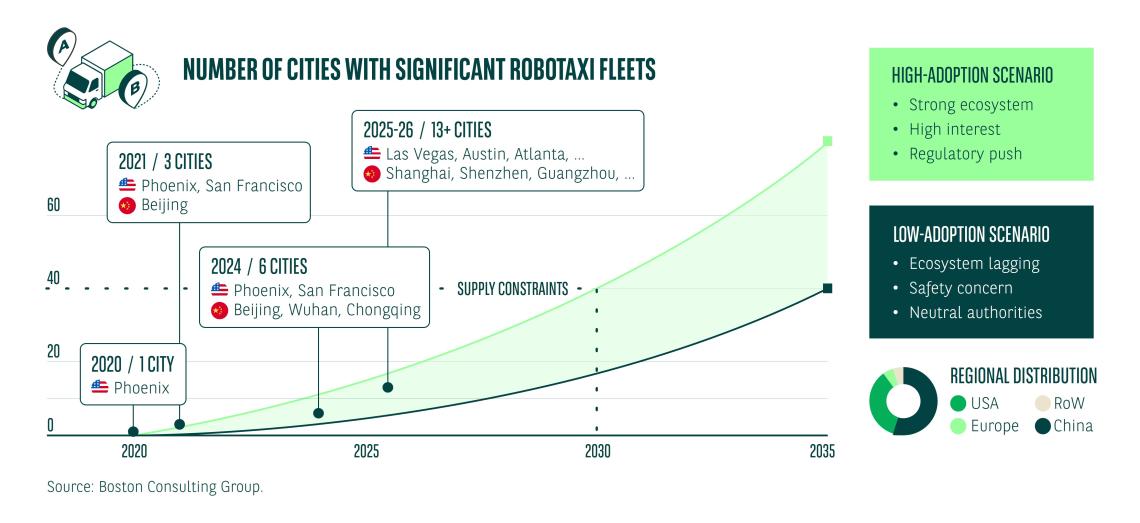
Description: Robotaxi deployment is currently centred in the US and China. Europe is expected to lag, prioritising public transport integration.
Autonomous trucking presents arguably the strongest business case. This economic rationale is twofold: the ability to address persistent driver shortages and significant productivity improvements generated by 24/7 operations. Fixed and predictable hub-to-hub highway routes demonstrate how autonomous trucking is gradually moving from testing to early operations. In the US, these vehicles are projected to account for nearly 30% of new truck sales for mid-distance hub-to-hub routes by 2035[5]. Autonomous trucks operating on hub-to-hub routes offer a compelling business case through higher asset utilisation, extended operating hours and improved resilience against driver shortages.
Autonomous light commercial vehicles could also support last-mile delivery operations, particularly in semi-controlled environments where efficiency gains and predictable routes facilitate deployment.
The implications for fleet operators vary considerably depending on the type of fleet.
For fully autonomous commercial fleets, such as robotaxis or last-mile delivery vehicles, success will depend not only on vehicle technology but also on operational capabilities. Fleet operators may need dedicated technical depots to support intensive vehicle utilisation, including charging, maintenance, repairs, cleaning and software updates.
For corporate passenger car fleets used by sales representatives or technicians, route planning and fleet management processes may remain relatively similar to today, while greater automation could progressively enhance employee productivity during travel.
Managing Expectations: Constraints, Limitations and Timelines
The barriers to widespread AV adoption are persistent – not temporary, as many would hope. Key constraints include:
- Regulatory fragmentation:
- The US still lacks an overarching federal framework.
- In Europe, fleet operators must certify vehicles country by country.
- In China, a comprehensive regulatory system isn’t expected until 2030[6].
- Liability and safety requirements: At level 4 and 5, liability becomes one of the most significant barriers to large-scale deployment. Today, road risk is distributed across millions of drivers. With L3+ autonomous vehicles, part of this responsibility shifts towards manufacturers and system providers. As AV deployment scales, risks could therefore become significantly more concentrated on OEMs and technology providers, increasing the importance of validation, certification and robust liability frameworks.
- Public acceptance: In a survey of nearly 37,000 respondents, 53% cited safety as the primary barrier to wider AV adoption[7].
- Technological edge cases: Complex urban environments restrict even the most advanced systems to controlled operational contexts.
- Cybersecurity and system resilience: Unlike conventional vehicles, autonomous vehicles depend on continuous data exchange, connected infrastructures and AI-driven decision-making. This increases exposure to cyber threats that could affect vehicle perception systems, communication networks or even critical driving functions. As a result, cybersecurity is emerging as a fundamental requirement for large-scale AV deployment, alongside safety validation and regulatory approval.[8]
Deployment timelines continue to shift. Large-scale level 4 robotaxi deployment, for instance, is now expected by 2030 rather than 2029[9]. This latest revision illustrates the gap between early expectations and operational reality, suggesting that even current forecasts may prove optimistic. Therefore, autonomous driving should not be approached as an imminent replacement of current mobility models, but as a progressive integration into specific segments.
A Gradual and Use-Case Driven Transformation
AVs are being progressively integrated into targeted use cases with clear operational logic. Hybrid operating models are also emerging, with ride-hailing platforms combining robotaxi services and driver-operated rides within the same offer. Framing this gradual development are the following key factors: incremental technological progress, strong regional disparities, human safety and selective deployment based on economic viability.
While deployment timelines remain uncertain and many forecasts may still prove optimistic, the strategic direction for fleet and mobility stakeholders appears clear: a
Autonomous driving will progressively transform selected mobility segments – including robotaxis, hub-to-hub trucking, and controlled logistics environments – rather than through sudden, large-scale transformation.
[1] Autonomous Vehicles: Timeline and Roadmap Ahead, WCF and BCG, Apr. 2025
[2] Autonomous Vehicles: Timeline and Roadmap Ahead, WCF and BCG, Apr. 2025
[3Autonomous Vehicles: The Human Factor Driving Consumer Readiness and the Future of Insurance, Scor, Feb. 2025
[4]Autonomous Vehicles: Timeline and Roadmap Ahead, WCF and BCG, Apr. 2025
[5Autonomous Vehicles: Timeline and Roadmap Ahead, WCF and BCG, Apr. 2025
[6]Autonomous Vehicles: The Human Factor Driving Consumer Readiness and the Future of Insurance, Scor, Feb. 2025
[7] Getting on board with shared autonomous mobility, McKinsey, Jan. 2025
[8]Cyber-resilient autonomous vehicles: securing networks and enhancing decision-making with next-gen security measures - ScienceDirect
[9]Where to next? Insights from autonomous-vehicle experts, Mckinsey, Jan. 2026